The word itself.
Theosophy is Greek - theos (god, the divine, the source) plus sophia (wisdom). Divine wisdom. It was used by the Neo-Platonists in the third century, by Christian mystics in the seventeenth, and by Helena Petrovna Blavatsky and her companions when they founded the Theosophical Society in New York in 1875. The same word, picked up from the same well.
Theosophy is not, in the Society's understanding, a body of doctrines you sign up to. It is an inquiry tradition - a name for the long human work of asking what reality is and how a person actually goes about meeting it. The name implies that there is something to find. It does not specify what you must believe about it.
What it is
It is a way of taking seriously the claim, found in nearly every wisdom tradition the human race has produced, that there is a unity beneath appearances, and that the seeker can come to know that unity directly - not by accepting someone's report of it, but by patient work on their own attention, conduct, and understanding.
The Society's three Objects, formulated in its first decade, hold this open in three movements:
- To form a nucleus of the Universal Brotherhood of Humanity - without distinction of race, creed, sex, caste, or colour. The first object is not a metaphysical claim. It is a social practice: a community that holds itself open to anyone who shows up to do the work.
- To encourage the study of Comparative Religion, Philosophy and Science - to read across what the human race has thought, in different vocabularies and different centuries, and notice where the deepest answers begin to converge.
- To investigate unexplained laws of Nature and the powers latent in man - to take seriously, as a working hypothesis, that the human person has more capacities than the materialist account assumes, and to test what one can.
None of these three are creeds. They are directions of attention. A serious Theosophist may end up holding very different beliefs from another serious Theosophist on the metaphysics, the cosmology, the practices. The discipline is not the conclusions, it is the inquiry that holds them open.
What it is not
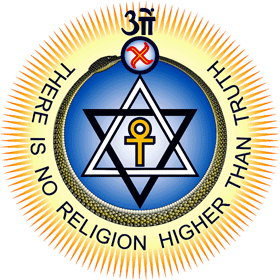
Theosophy is not a religion. The Society has never required allegiance to any belief about God, the soul, karma, reincarnation, or anything else. Members are free to be Hindus, Buddhists, Christians, Muslims, Jews, atheists, agnostics, or none of the above. The motto on every page of this site - satyāt nāsti paro dharmaḥ, "there is no religion higher than truth" - is the Society's working stance. Truth, where it can be approached at all, is approached by inquiry, not by partisanship.
Theosophy is not New Age, and the Society predates the New Age movement by a century. There is no crystal-healing, no manifestation, no abundance, no aesthetic of self-help-with-incense in the original Theosophical writings. What there is, in HPB and Annie Besant and the early teachers, is a difficult, demanding, and largely unsentimental philosophy that asks the reader to do real work on themselves and to read seriously across traditions.
Theosophy is not a guru-tradition. The Society has had remarkable people in it - its founders, its presidents, the writers and teachers who have carried it forward - but it has never asked anyone to follow a single living teacher or to accept their pronouncements as authority. Each member is free to walk their own inquiry, in their own time, in dialogue with the tradition and with their own conscience.
Theosophy is not free in the sense of being effortless, but it is free in the sense of open - open to anyone who wants to do the work. There is no membership fee at the door. There is no entry exam. The Society's lodges are public, the books are in libraries, the gatherings welcome strangers.
Where YIT fits
Young Indian Theosophists is the youth wing of this lineage in India. The Society's international headquarters has been at Adyar, on the Madras coast, since 1882 the Indian Section sits at Varanasi (Kashi), the ancient seat of philosophical study. We are students, professionals, artists, and seekers - gathered, in our own time, to do what generations before us have done: study, meditate, serve, and meet each other in real rooms.
We hold an annual Gathering - six days in June, somewhere in India. We publish a magazine called Turiya. We keep a working shelf of books, voices, and noticings - opinions held loosely, returned to often. We do not ask that you become a Theosophist. We do ask that you, like us, take your own questions seriously.
If you are new and want to know where to start
Read the About page for a fuller history of the Society and our place in it. Open the Reading Atlas for an honest, opinion-loose map of the books worth your time. Read Old Lamps for ten quiet pieces of the Society's hundred-and-fifty-year story. If you find a question that won't leave you alone, write to us.
— The Editors, YIT